 Shimira IT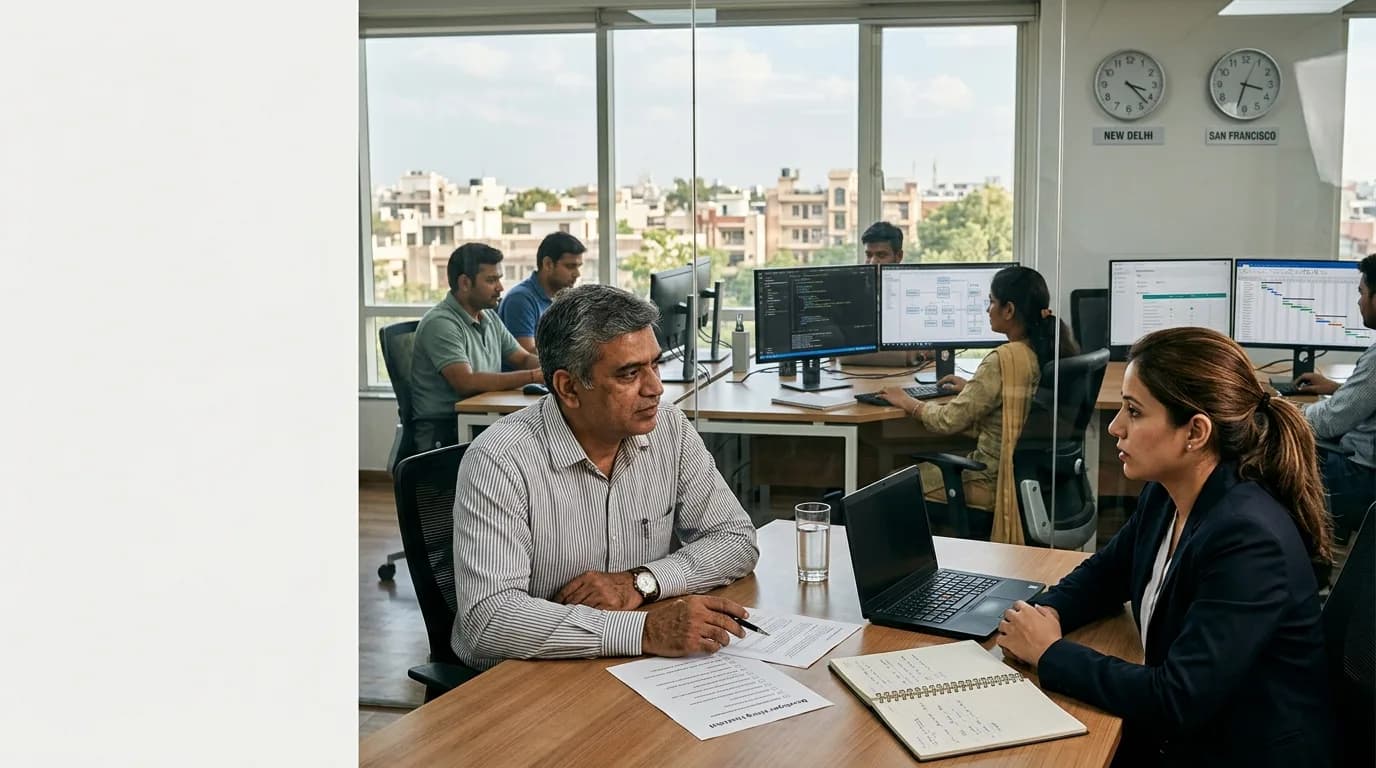
Most articles about hiring developers in India are written to rank, not to help. They repeat "cost-effective" and "large talent pool" a dozen times and tell you nothing you couldn't guess. This one is written by a company that actually runs a senior engineering team in New Delhi for US and European clients — so it's about the decisions that determine whether the engagement works, not the clichés.
If you're evaluating India as where to build your software, here's what genuinely matters.
The "India Is Cheap" Framing Is Costing You Money
The reason most India engagements disappoint has nothing to do with India. It's that buyers arrive anchored on price, select on the lowest hourly rate, and get exactly what they optimized for: junior developers, high rework, and a product that costs more in total than a mid-priced team would have.
The 2026 reality is a split market. Junior and offshore-body-shop work still exists at $15–$25/hour — and it still produces the horror stories. At the same time, senior Indian engineers specializing in AI, cloud, and modern web stacks now bill $50–$90/hour and deliver output indistinguishable from Western senior talent. That's still less than half of the $110–$200+ a comparable US senior engineer costs, but it's a different purchase entirely from the bargain tier.
The buyers who succeed in India aren't the ones who found the cheapest rate. They're the ones who found senior talent at a rate that happens to be efficient. We break the full picture down in our guide to software development hourly rates by region — the India section specifically explains the seniority split.
The Timezone Question, Answered Honestly
The real objection to India isn't cost or quality — both are solved at the senior end. It's the ~9.5–12.5 hour gap to US time zones. Pretending this doesn't exist is how engagements fail; engineering around it is how they work.
Here's what an honest partner does with it:
- Structured overlap hours. Our team maintains a defined window that overlaps US mornings and European afternoons — the hours reserved for live calls, demos, and decisions. The gap becomes a feature: you hand off work end-of-day and review completed progress the next morning.
- Asynchronous discipline. Timezone gaps punish teams with weak written communication and reward teams with strong process — clear tickets, recorded demos, decisions documented not just discussed. This is a process capability, and it's fair to test it before you commit.
- A single accountable contact in your window. The outsourcing nightmare is "who do I even call." A senior lead who owns your account and is reliably reachable in your hours removes it.
For EU clients the gap is smaller and easier; for US clients it's real but entirely workable with the right structure. What you should refuse is a partner who waves the question away.
What India Genuinely Offers That Other Regions Don't
Setting the clichés aside, two advantages are real and specific:
Depth of senior talent at every tier. Latin America and Eastern Europe are excellent but smaller markets — scaling a team quickly, or finding a rare specialization, is harder. India's scale means a senior AI engineer, a cloud architect, and three product engineers can be assembled and scaled without a six-month talent search. When your roadmap needs the team's composition to change between phases, this flexibility is worth more than a few dollars of hourly rate.
A mature outsourcing ecosystem. Two decades of serving Western clients means the good firms have solved the operational problems — contracts, IP assignment, data handling, communication cadence — as standard practice rather than improvisation. (The flip side: the ecosystem also contains two decades of bad firms. Selection matters more here than anywhere.)
How to Not Get Burned: A Selection Checklist
The variance between Indian development firms is enormous — larger than the variance between regions. These filters separate the two tiers:
- Interview the actual engineers, not the sales team. The gap between who pitches and who codes is the single most common India-engagement failure. Insist on technical conversations with your assigned developers. Our vetting checklists for AI, Next.js, and full-stack engineers work on any firm's candidates.
- Demand itemized, phase-by-phase pricing. A lump sum with a suspiciously cheap discovery phase is engineered to grow. Compare any quote against our published cost guide.
- Verify the seniority you're paying for. Ask who specifically is on your team and what they've shipped — some firms quote senior rates and staff juniors.
- Test written communication early. Request a written project understanding after your first call. Its clarity predicts your entire async experience.
- Confirm IP and code ownership in writing, in your name, from day one.
We wrote a fuller version of this as how to choose a software development company — every filter there applies doubly in a high-variance market.
Whether to Hire a Team or Commission the Build
Two ways to work with an Indian partner, worth choosing deliberately:
- Dedicated team / staff augmentation — senior engineers embedded in your team, in your repo and standups, billed monthly. Best when you have technical leadership in-house and need capacity. See our full-stack team model and Node.js and Next.js developer hiring.
- Project-based delivery — a scoped outcome, designed and delivered, via our custom software development services. Best when you want a result rather than headcount.
If you're still weighing India against building in-house at all, our in-house vs outsourcing cost comparison runs the real numbers.
Why Shimira IT
We're a New Delhi-based custom software company built specifically for the senior end of this market: TypeScript, Node.js, React/Next.js, PostgreSQL, and AI/ML engineering, led by senior architects who work directly with your stakeholders in your timezone. Published pricing, itemized proposals within 48 hours, interviews with your actual engineers, and full code and IP ownership from day one. We serve clients across the US and Europe, and we'd rather lose a deal to honesty than win one we can't deliver.
Tell us what you're building — you'll get a senior technical response and a phase-by-phase estimate within 48 hours, not a sales sequence.